

Before beginning I want to acknowledge that yes, Asana (the physical shapes of Yoga) is one of eight limbs of the practice; meaning, the physical alone is not the complete, and certainly not the only path of Yoga. However, let’s stop sh*tting on it. Asana brings many people to their mat. It’s not what keeps them there. Its a doorway, but its up to each of us to continue walking that path.
I celebrate the physical because it reflects so much of the non-physical, in a language that is digestible for people like me, who have lived life through the sensations of the body. So, thank you body, and thank you Asana, for teaching me lessons on the mat so that I can live them off of it.
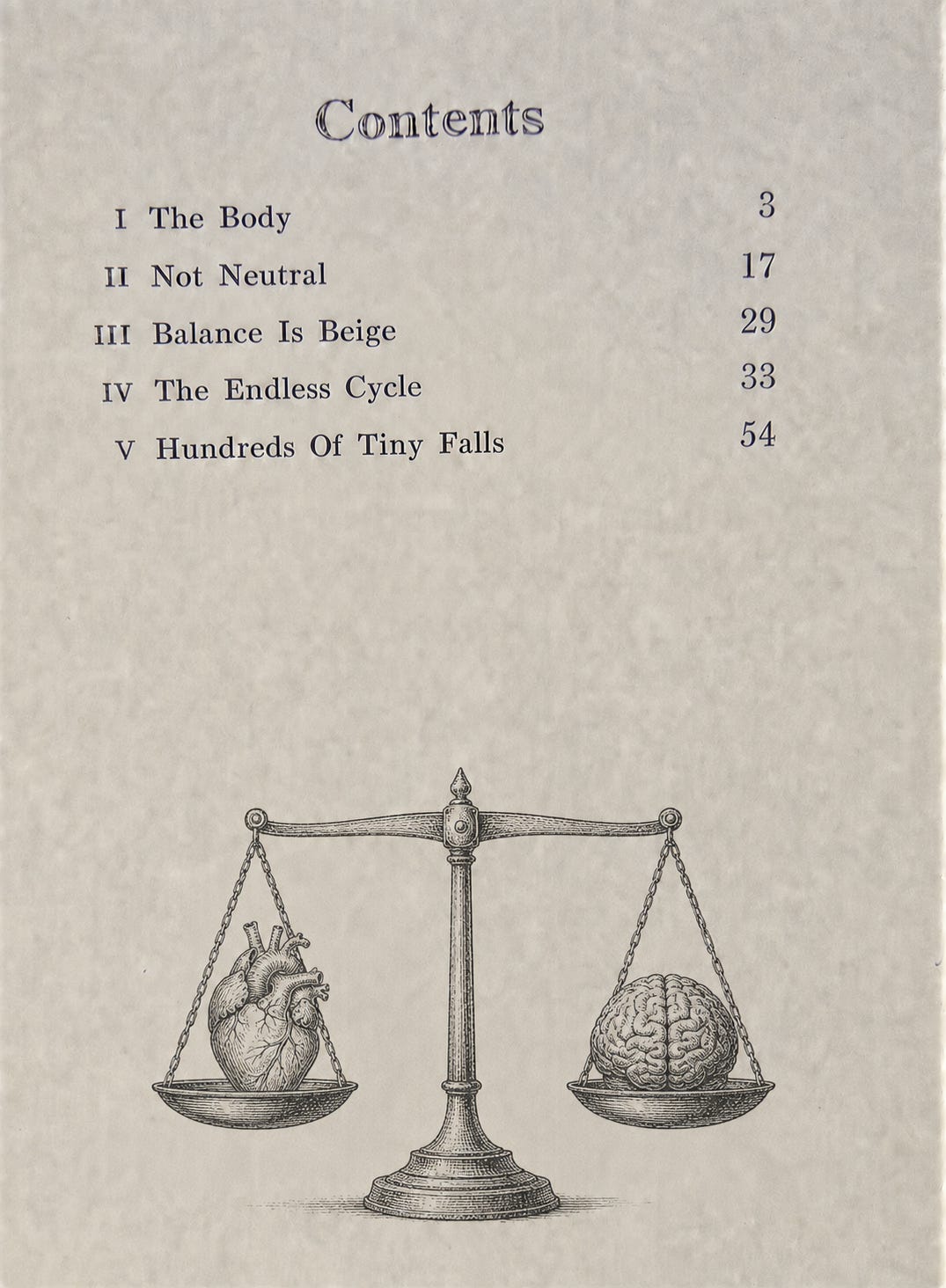
The Body
A balancing asana (pose/shape) in yoga is not stillness. Take Vrksasana ,“tree pose”, for example. It might look like it from across the room, but once you look closer, it’s the foot micro correcting hundreds of times a second; Hundreds of tiny little falls, caught just at the edge.
Balance is a kaleidoscope of movements, it’s a direction that we’re constantly expected to course correct to, but what it is not is a destination we arrive to and stay at.
To know balance, we must know the edges around it. We need constant movement, a swaying from side to side; Toes gripping and releasing, seasons of opposition versus the other.
Not Neutral
What balance is not is neutral. It’s not that our salad cancels out our fries. It’s not a zero-sum game. It’s not even staying at center. It’s a continuously moving through center, swinging side to side to side to side…
Seasons of down versus seasons of up. Seasons of stewing in nostalgia versus using that nostalgia to inspire a change in your life.
It does not mean we need one thing plus its opposite in order to find neutrality, to find an accommodating beige within our palette that will go with everything we pair it with.
What it does mean is this:
Being able to hold two things that oppose each other at the same time without diluting either of them. 1+1 = 11.
Knowing that when we are on the edge of something, we have trust in the inner wisdom that we will eventually swing back the other way. We will eventually come home. A trust in the body and the mind.
An inhale and an exhale, not because they cancel each other out, but because they both do something for us.
A woman’s menstrual cycle is an excellent example of this. There are weeks we may want to be a hermit, weeks we want to feel social. We don’t need to let either define us, and we certainly do not and should not aim to always feel right in the middle of those.
Think about the tide too, (one with salt in the water, of course); Highs, lows, never neutral, literally always changing. The ocean has a constant rhythm, and without it, it’s just a big old puddle.
How boring would life be if it was level all the time? I, for one, think really f*cking boring.
A salad and fries is not balance. The balance is eating whatever the f*ck you want, but trusting yourself enough, having so much love for yourself, that you want yourself to feel good. And so, you swing back to that center eventually. Even if that means eating “crap” this weekend, or having the fries tonight.
Balance is Beige
I think we’ve failed ourselves a bit by tying self-optimization to balance.
The corner of the world that tells us we should feel level all the time, and that a bad week means we have to have a good one next week, makes people feel broken for meeting their edge.
When instead, that bad week was probably one of the most informative weeks of your life. By feeling the feelings of a bad week, we get to know ourselves, and only then can we know which direction we want to sway back to eventually.
It’s okay to want the door to be open, to want to be seen, and to have seasons of the exact opposite.
It’s okay to want to be the host and the hermit.
It’s okay to wonder why you were cursed with things out of your control but then learn to fall in love with your life and it’s especially okay to change your opinion on it.
To stay safe, in the middle, neutral ground, means a beige life.
It’s also a bit cowardly, and I am the first person to say that I do this, and I do it a lot.
I get nervous to share my opinion if it’s not backed in science for fear of being seen. At the same time am writing on Substack, for my words to literally be seen. How boring is that? To put yourself in front of people and then borrow other people’s opinions because you don’t want to stray too far to the edge? Wake up call for me.
Saṃsāra: The Endless Cycle
Saṃsāra, the endless cycle of birth, death, and rebirth, is derived from two important pieces of Sanskrit:
1. “Saṃ”, meaning together/with/completely
2. “sṛ”, meaning to flow/to run/to move
Put those together and saṃsāra then means “flowing together”, or “moving through”. So, the literal bones of the word are forms of motion. This big wheel that we train ourselves to believe we’re stuck on is constructed from a word that simply means continuously moving.
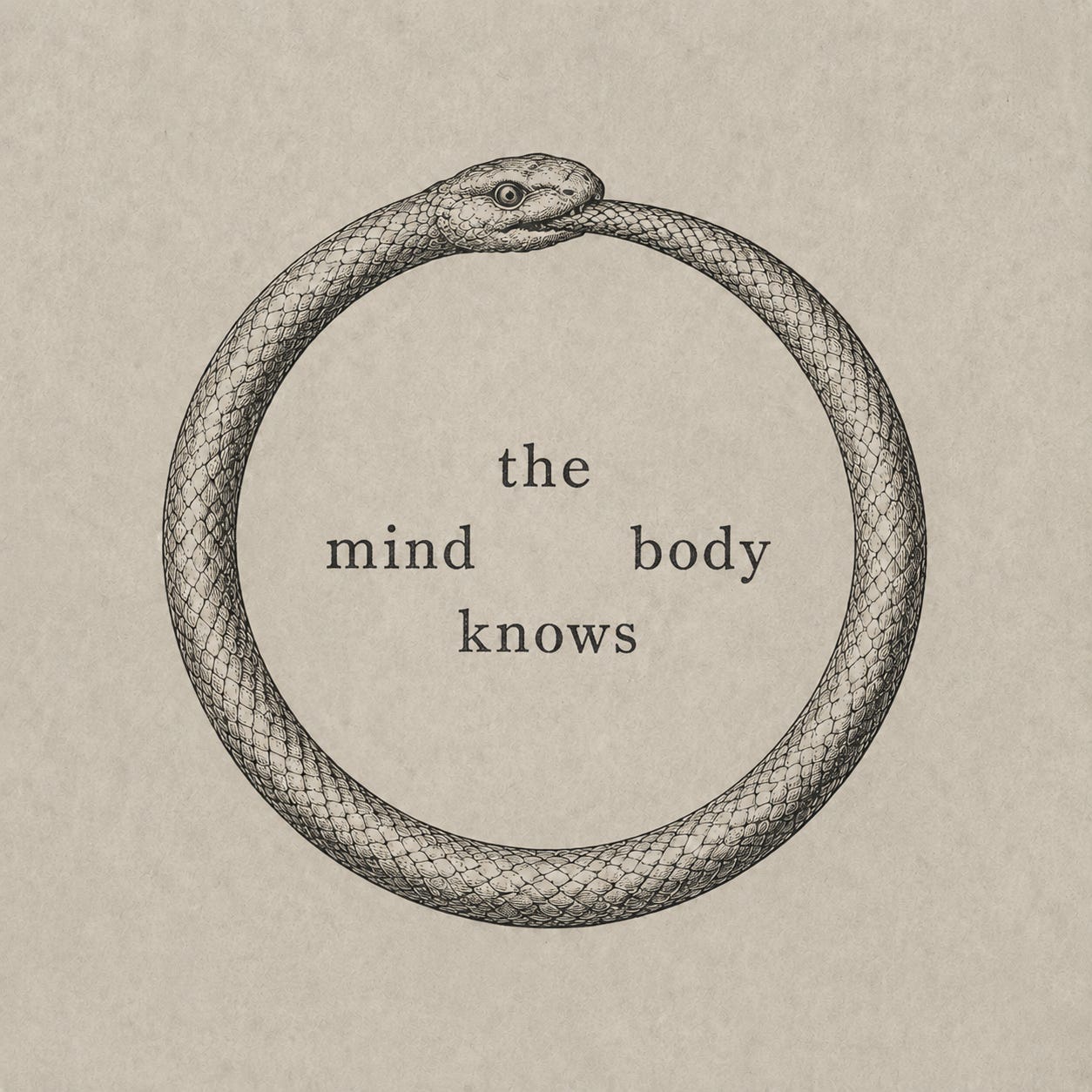
Traditionally, we talk about liberating ourselves from saṃsāra. I’d like to celebrate it.
The way I understand it, freedom doesn’t lie in completely opting out of cyclical movement; it lies in the decision not to be dragged along by it. To swim with the current instead of against it.
We are not balancing ourselves by simply choosing the opposite. We are not balancing by canceling out. This misuse of the word “balance” and our obsession with it is like covering a fun wallpaper with beige paint. It’s pushing through saṃsāra, by choosing to opt out of the cyclical movement of life, and settling for what feels safe right now.
Hundreds of Tiny Falls
I am kinda scared to write anything that doesn’t have “proof”, a scientific source to back it. Then, I wrote these ~1000 words without nothing behind them except what I have literally learned from trying to balance on one foot, or on my hands, in a 95-degree room. So, that’s a fall… caught, barely… just at the edge.
That’s all any of this human experience is.
Hundreds of tiny corrections, none of them arriving anywhere, all of them keeping us upright.
A life is not made complete by being level. It is made complete by being lived fully at both edges.